

Women and Gambling Addiction: Why It Stays Hidden — And How Treatment Helps
The phone usually rings before she’s ready to say her name. There’s a pause on the other end, just long enough for me to know this call took real courage to make. As an admissions director, I’ve learned to listen not just to the words someone says, but to the silence around them, and when a woman calls asking about gambling treatment, that silence often tells me more than anything she’s about to say out loud.
Many women don’t come to treatment because they’ve hit rock bottom the way people usually picture it. They come because something quietly became unbearable: a secret credit card, a bank account she stopped checking months ago, a knot in her stomach every time her phone lights up. Shame stacked on top of everything else she’s responsible for, her kids, her partner, her parents, her career. She’s held it all together for so long that asking for help starts to feel like the one thing she isn’t allowed to need. So when she finally does call, how we meet her in that moment matters enormously.
The Weight She’s Carrying
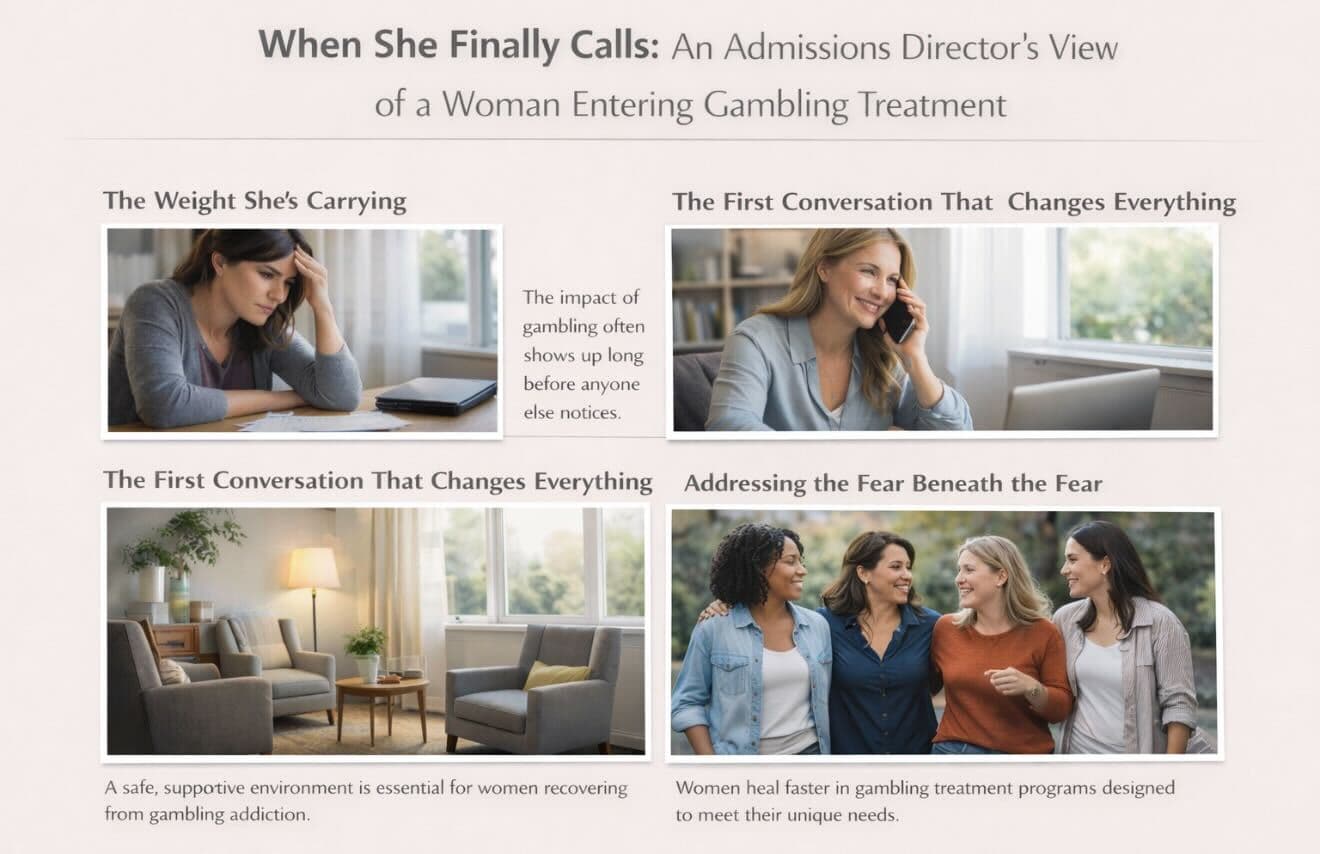
Women entering gambling treatment tend to arrive carrying a very particular kind of isolation. Gambling disorders in women are typically quieter, more hidden, and more tightly bound up with emotional survival than the pattern we see in men. Most of them aren’t chasing a thrill. They’re chasing relief, from anxiety, loneliness, trauma, grief, or the relentless pressure of being everything for everyone else in their lives. By the time she reaches admissions, she’s usually already convinced herself she’s failed, failed her family, failed herself, failed at controlling something she assumed she should have been able to handle on her own. My job in that first conversation isn’t to total up her losses or assess her finances. It’s to help her see that what she’s living through is a treatable condition, not a personal flaw, and that she is not the only one.
The Moment the Guard Comes Down
There’s often a specific turning point in these calls. Sometimes it comes when I tell her she’s not the first woman who’s said this to me. Sometimes it’s when I explain how quickly gambling tends to escalate once it becomes a coping mechanism instead of entertainment. Sometimes it’s simply the moment I slow down and stop rushing her toward logistics and paperwork. That’s when the emotion finally breaks through, tears, anger, exhaustion, relief, often all at once. Women frequently apologize for crying on these calls, and I always tell them the same thing: this is exactly where you’re allowed to do that. Admissions isn’t just an intake process. For a lot of women, it’s the first time they’ve said the truth out loud without trying to soften it or make it sound less serious than it actually is.
Addressing the Fear Beneath the Fear
The questions she asks rarely have anything to do with schedules or insurance, not really. They’re about safety. Will I be judged? Will anyone actually understand why I gambled in the first place? What happens to my family if I step away for treatment? Does this mean I’m going to be an addict forever? A lot of women worry they’ll be seen as irresponsible or selfish, and many fear that treatment will somehow strip away their identity as a caregiver or a professional. Part of my role is reframing that fear entirely, helping her see treatment not as abandoning her responsibilities, but as the most responsible choice available to her. We talk through confidentiality, gender-responsive care, trauma-informed therapy, and what it actually looks like to rebuild trust with herself before she tries to repair everything else. And I’m
honest with her: recovery isn’t quick or easy. But it is possible, and I’ve watched women rebuild lives they were certain were permanently broken.
Why Gender Matters in Gambling Treatment
One of the most important things I try to communicate from an admissions standpoint is that women do better in environments where they don’t have to explain or defend their experience to people who don’t understand it. Many women with gambling disorders are also carrying histories of trauma, anxiety, depression, or relational loss, and treatment has to be built to honor all of that complexity at once. When women feel genuinely safe, understood, and respected, they engage differently from the start. They open up faster. They stay longer. They heal deeper. I’ve watched women arrive at our doors guarded and ashamed and leave with real clarity, real boundaries, and a renewed sense of agency, not because we fixed them, but because we gave them the space to reconnect with parts of themselves that gambling had slowly taken over.
The Courage It Takes to Walk Through the Door
I never forget that admissions is often the hardest single step in the whole process, harder than the first therapy session, harder than the first group. Before any of that happens, picking up the phone means admitting that something has gone too far, and trusting a complete stranger to respond with care instead of judgment. When a woman enters gambling treatment, she isn’t weak. She’s brave in a way that rarely gets enough credit. She’s choosing to face discomfort instead of numbing it, honesty over secrecy, herself, often for the first time in years. And from where I sit, answering that call day after day, I can say this with real certainty: the moment she reaches out isn’t the end of her story. It’s the beginning of a much stronger one.
Sources
New York Council on Problem Gambling — Women Research Data Summary
Birches Health — Women and Gambling: Female Betting Stats & Addiction Rates
Florida Council on Compulsive Gambling — Shining the Light on Women and Problem Gambling